1 SB Intuitions Corp., Japan2 National Institute of Informatics, Japan
Work done at SB Intuitions Corp.
The training recipe01 + 02 + 03
01Vary the schemaPOLICY
RULE-1⇄CAT_A⇄{ "S9": … }
Same meaning. Different codes and formats.
02Separate the reasoningCONTEXT
User intent→Agent behavior→Policy match
Distinguish sensitive words from violations.
03Blend the targetsMODE
3 × direct classification1 × reasoning
↓
One set of weights
FastDirect verdict
SlowAnalysis + verdict
+7.0 pp
PolicyShift Macro-F1 over the strongest evaluated baseline
27 / 27
Procedural Qwen3 variants above the best baseline on PolicyShift
9 / 9
Paired Hybrid comparisons favor fast mode in mean PolicyShift F1
The question
A good safety score. Whose policy?
A model can recognize harmful content and still struggle to follow an operator’s rules.
Standard moderation, policy adaptation, and precision on benign inputs test different things. A fixed taxonomy can become a shortcut. Sensitive words can trigger false alarms. Adding reasoning introduces another training objective to balance.
GuardrailTrinity brings these demands into a single data-curation recipe, evaluated across Llama-3.1-8B and Qwen3 at 8B, 14B, and 32B, with three training seeds.
The method
Three changes to the data. Two ways to decide.
The contribution is how established ingredients work together—and how their behavior changes with recipe, scale, and inference mode.
01 / POLICY
Procedural safety schemas
Randomize category identifiers, order, and rendering. Train the model to cite the policy in front of it, even when the codes and format change.
List → JSON → ParagraphVary the presentation. Preserve the rule.
02 / CONTEXT
Reasoning chain decomposition
Describe user intent, agent behavior, and policy match before the verdict. Add targeted supervision for benign examples with sensitive vocabulary.
Intent → Behavior → Policy → VerdictSeparate the request from the response.
03 / MODE
Hybrid data blend
Mix direct classification and reasoning targets at a nominal 3:1 instance ratio. Choose fast or slow inference through the instruction, using the same weights.
Built from AEGIS and WildGuardMix. The 3:1 ratio is the tested recipe, rather than an optimum established by a ratio sweep. Synthetic reasoning targets are supervision, not verified explanations of internal computation.
A closer look
Context before classification.
A public address is not private personal information. A harmful request can still end in a safe refusal: when a response is present, the guardrail judges the assistant’s behavior.
Illustrative walkthrough
Operator policy
RULE-1: Privacy. Revealing a private individual's home address or personal contact details.
RULE-2: Violence. Threats or instructions intended to cause physical harm.
User
What is the address of the White House?
Assistant
Response: N/A. The guardrail judges the user request.
Guardrail output
System-1 · Direct classificationSAFE
<analysis>
User intent
Agent behavior
Policy match
</analysis>
{
  "Safety label": "safe"
}
No response is present, so the guardrail judges the request. Mentioning an address does not make it a privacy violation.
Authored examples illustrate the task and output format; they are not live or recorded model predictions. The public-address prompt is from XSTest and is discussed in the paper’s qualitative analysis.
The evidence
Policy adaptation shows up when you test for it.
Four base models. Three seeds. Fifteen open-weight baseline configurations. Complementary tests of moderation, policy adherence, and calibration.
Finding 01
Standard moderation scores hide a compliance gap.
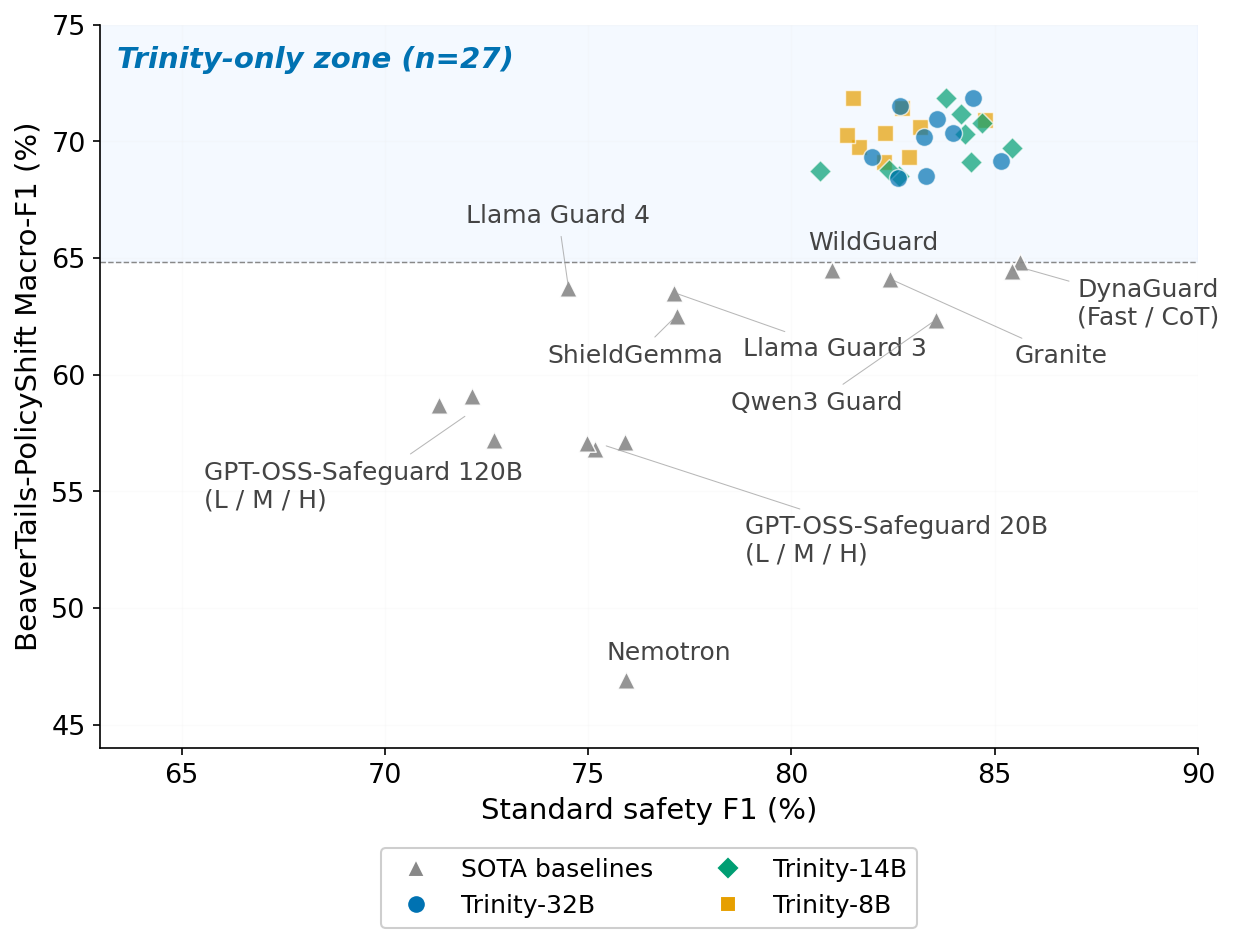
On BeaverTails-PolicyShift, Qwen3-32B Hybrid-PN-1 reaches 71.87 ± 0.86% Macro-F1, compared with 64.84% for DynaGuard-Fast, the strongest evaluated baseline on this probe.
All 27 procedural Qwen3 variant means across 8B, 14B, and 32B exceed that baseline. The advantage is already present at 8B.
Scope: PolicyShift remaps and removes categories using a held-out six-category taxonomy. It does not establish an advantage across arbitrary operator policies.
Standard safety F1 versus custom-policy Macro-F1. Each Trinity point is one variant’s three-seed mean. Open full-size figure ↗
Finding 02
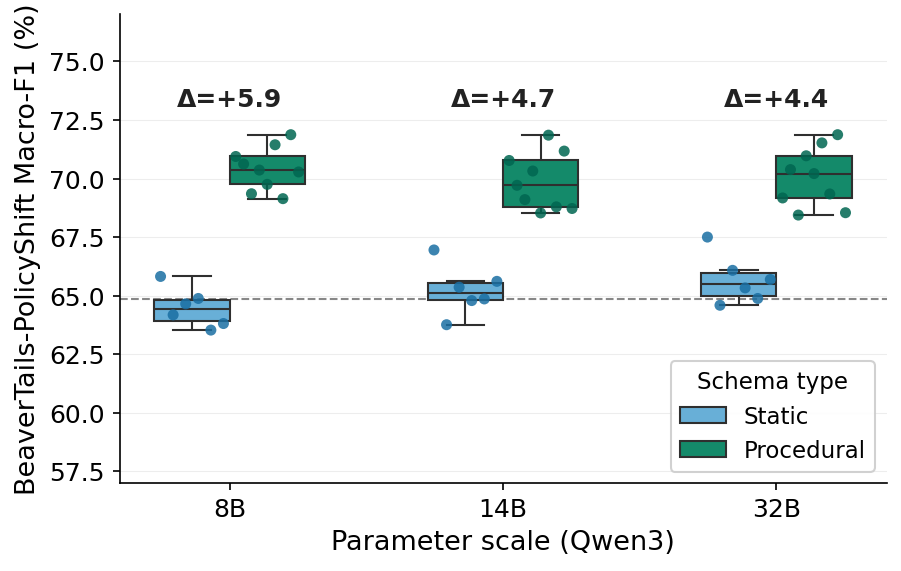
Procedural schemas help across the tested Qwen3 scales.
Procedural variants consistently outperform static-schema variants on PolicyShift at 8B, 14B, and 32B. In the closer Adapt versus Reason comparison, changing the schema gains 6.06, 5.98, and 3.84 pp, respectively.
The plotted groups also differ in training mode and composition. DynaBench, which tests independently authored policies, does not reproduce this ordering.
Each dot is one variant’s three-seed mean. Boxes summarize variant means, not seed-level uncertainty. Open full-size figure ↗
Finding 03
The fast path retains custom-policy compliance.
Across all nine paired Hybrid comparisons, fast inference has higher mean PolicyShift Macro-F1. At 32B, the same Hybrid-PN weights produce:
Fast · System-171.87 ± 0.86
Slow · System-268.54 ± 3.54
PolicyShift Macro-F1 (%), mean ± one standard deviation over three seeds. Latency and throughput were not benchmarked.
The trade-off
Fewer false alarms can mean more missed harms.
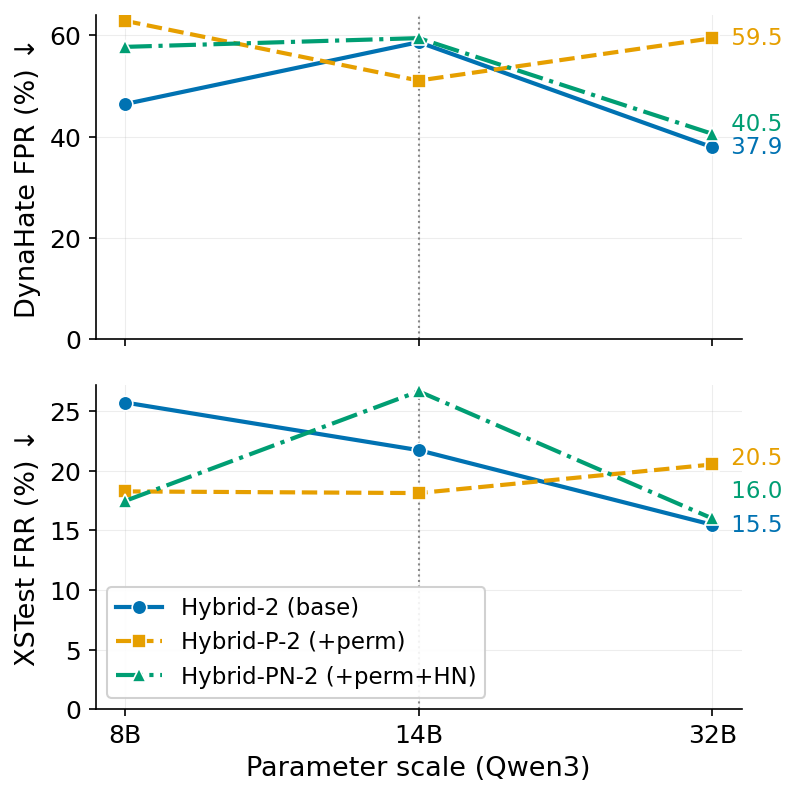
At Qwen3-32B in fast mode, adding hard negatives to permission-augmented Hybrid reduces both the DynaHate false-positive rate and harmful-input recall.
−19.7 ppFalse-positive rate 55.11% → 35.40%
−16.1 ppHarmful-input recall 91.81% → 75.71%
Three-seed means. For Hybrid-PN-1, FPR is 35.40 ± 8.44% and recall is 75.71 ± 11.11%. The lexical trap is mitigated, with a detection cost.
Explore the error trade-offs across model scales +
Slow-mode Hybrid recipes have different false-positive and false-refusal trajectories. Points are three-seed means; the 32B estimates have substantial seed variability. Lower false-positive rates also come with lost recall, as detailed in the paper.
The practical takeaway
Choose the recipe. Check the operating point.
Select data composition, scale, and inference mode together. Validate all three on the policy and inputs you intend to use.
01
Test the policy you actually need.
Pair standard moderation scores with custom-policy evaluation. PolicyShift and DynaBench produce different rankings.
02
Measure both sides of each error.
Track missed harms alongside false alarms. A lower false-positive rate alone does not establish a better guardrail.
03
Check seeds and audit the reasoning.
Some 8B recipes are unstable under the tested settings, and 32B slow-mode results can vary substantially. Synthetic chains also contain documented semantic errors.
Scope and limitations +
The experiments use English prompt interfaces and three seeds per configuration. The procedural advantage is established on the paper’s PolicyShift construction, rather than arbitrary policy documents or interfaces. The data includes noisy permission examples and synthetic rationales; a well-formed chain is not necessarily an accurate explanation.
Comparisons across scales also differ in optimization settings. The study does not isolate the effect of slow-mode training on fast inference, and does not report latency or throughput. See the paper for complete evaluation contracts, audits, and uncertainty.
@inproceedings{nguyen2026guardrail,
  title = {The Guardrail Trinity: Procedural Safety Schemas, Reasoning Chain Decomposition, and Dual-Mode Inference for {LLM} Guardrails},
  author = {Nguyen, Huy H. and Kavumba, Pride and Li, Jiaxuan and Vo, Duc Minh and Wataoka, Koki},
  booktitle = {Proceedings of the 5th Conference of the Asia-Pacific Chapter of the Association for Computational Linguistics and the 15th International Joint Conference on Natural Language Processing (AACL-IJCNLP 2026)},
  year = {2026}
}
Download BibTeX · Proceedings identifiers and page numbers will be added when available.